

In the early stages of a startup, “the cloud” is usually an afterthought. It’s handled by whoever set up the first repository, often a CTO or a Lead Developer who is already wearing five other hats.
It works until it doesn’t.
In the beginning, your infrastructure is just a collection of scripts and instances kept alive between feature sprints. You deploy, you fix issues on the fly, and you keep things running just enough to support your early adopters. But as your product gains traction, infrastructure stops being a background task and starts becoming a bottleneck.
The real question isn’t whether you need a cloud engineer. It’s when the transition from generalist-led infrastructure to specialist-managed systems becomes a requirement for survival. Hire too early, and you risk over-engineering and burning runway. Hire too late, and technical debt, downtime, and spiraling costs can cripple your momentum.
Here is the breakdown of the four clear signals that it’s time to hire a cloud engineer.
1. When Infrastructure Complexity Exceeds Generalist Knowledge
There is a vast, often underestimated difference between deploying a functional application and managing a scalable, resilient cloud architecture.
Early on, a full-stack developer can set up a basic AWS or Azure environment. However, as you scale, the “plumbing” of your software becomes significantly more complex. If your senior developers are spending 30% of their week debugging VPC configurations, Load Balancer latencies, or managing Kubernetes clusters instead of building product features, you have reached a critical inflection point.
This is a matter of Opportunity Cost. Every hour a high-paid software engineer spends on infrastructure is an hour they aren’t spending on the unique IP that makes your company valuable.
According to the HashiCorp State of Cloud Strategy Report, 71% of organizations cite skills shortages as the primary barrier to cloud maturity. This is because generalists can build functional infrastructure, but scaling and optimizing it requires a specialized mental model. Dedicated cloud engineers ensure your systems are built for scale from the start, rather than being patched together under pressure.
This transition is vital because it’s where specialized expertise begins to how cloud engineers improve devops by streamlining deployment pipelines and removing the friction between code and production.
2. When You Enter High-Stakes Compliance Environments
If your company is moving into Enterprise B2B, Fintech, Healthcare, or any SaaS sector with a global user base, your infrastructure requirements change overnight. Compliance is no longer a “nice-to-have” checkbox—it is a barrier to entry.
Frameworks like SOC 2, HIPAA, and GDPR require deep, infrastructure-level implementation. You cannot simply “document” your way into compliance; you must prove it through your architecture. A generalist developer might understand the concept of security, but a Cloud Engineer understands the execution of:
- Encryption: Managing keys and ensuring encryption at rest and in transit across all services.
- Identity and Access Management (IAM): Implementing “Least Privilege” protocols so a single compromised account doesn’t sink the ship.
- Audit Trails: Setting up immutable logging systems that satisfy rigorous third-party audits.
If your infrastructure is currently the reason you are losing enterprise deals or failing security audits, you aren’t just late to hire, you are losing revenue.

3. When Growth Starts Breaking Your System
Scaling is where most infrastructure cracks finally show up. If your platform slows down during traffic spikes, experiences frequent downtime under load, or takes longer and longer to recover from minor outages, you are facing a structural scalability problem.
Software engineers are trained to optimize code; Cloud Engineers are trained to optimize systems. They specialize in:
- Horizontal Scaling: Ensuring your app can add more “nodes” automatically as traffic grows.
- High Availability: Designing “Self-Healing” architectures that can survive the failure of an entire data center region.
- Disaster Recovery: Having a tested, automated plan to bring the system back online in minutes, not hours.
A key metric to watch here is MTTR (Mean Time to Recovery). If your MTTR is increasing even as your user base grows, your infrastructure is not scaling with your business—it’s resisting it.
This isn’t just about keeping the lights on; it’s about the bottom line. Specialized cloud management is central to how cloud engineers improve performance and cost efficiency, ensuring that your system stays fast and reliable without ballooning your budget.
4. When Your Cloud Bill Becomes a “Black Box”
This is perhaps the most common “emergency” trigger for a hire. Your AWS, Azure, or Google Cloud bill keeps increasing month-over-month, but no one on the team can clearly explain why.
This usually happens due to “Cloud Sprawl”—a combination of over-provisioned resources, idle instances, and inefficient storage usage. Without a specialist, most startups simply pay the bill and hope for the best.
A Cloud Engineer brings FinOps discipline to your infrastructure. They treat “Infrastructure as Code,” which provides total transparency. They can:
- Track costs down to a specific feature or microservice.
- Implement auto-scaling and “rightsizing” to ensure you only pay for what you use.
- Introduce “Spot Instances” or reserved capacity to slash costs by 40-70%.
Gartner has consistently noted that through 2026, organizations that do not have a dedicated cloud cost optimization strategy will overspend by an average of 30%. If your cloud costs are growing faster than your product revenue, a Cloud Engineer is no longer an expense; they are a savings vehicle.
The Strategic Question: Build vs. Hire
Once you recognize the need, the next challenge is the talent market. Cloud Engineers are among the most difficult roles to recruit. They are highly in demand, expensive in local tech hubs, and often require months to find.
For many bootstrapped or growing startups, the smarter approach isn’t a traditional full-time hire in your local city. Instead, savvy founders are looking at a hybrid model:
- Start with Experienced Remote Talent: Accessing global markets allows you to find senior-level expertise at a cost-to-skill ratio that fits your runway.
- Use Fractional Expertise: If you aren’t ready for a full-time role, bring in a Cloud Engineer on a project basis to set up your core architecture and compliance protocols.
Scale as You Grow: Transition to a full-time managed team as your infrastructure complexity justifies the permanent overhead.

Why Timing Matters More Than the Hire Itself
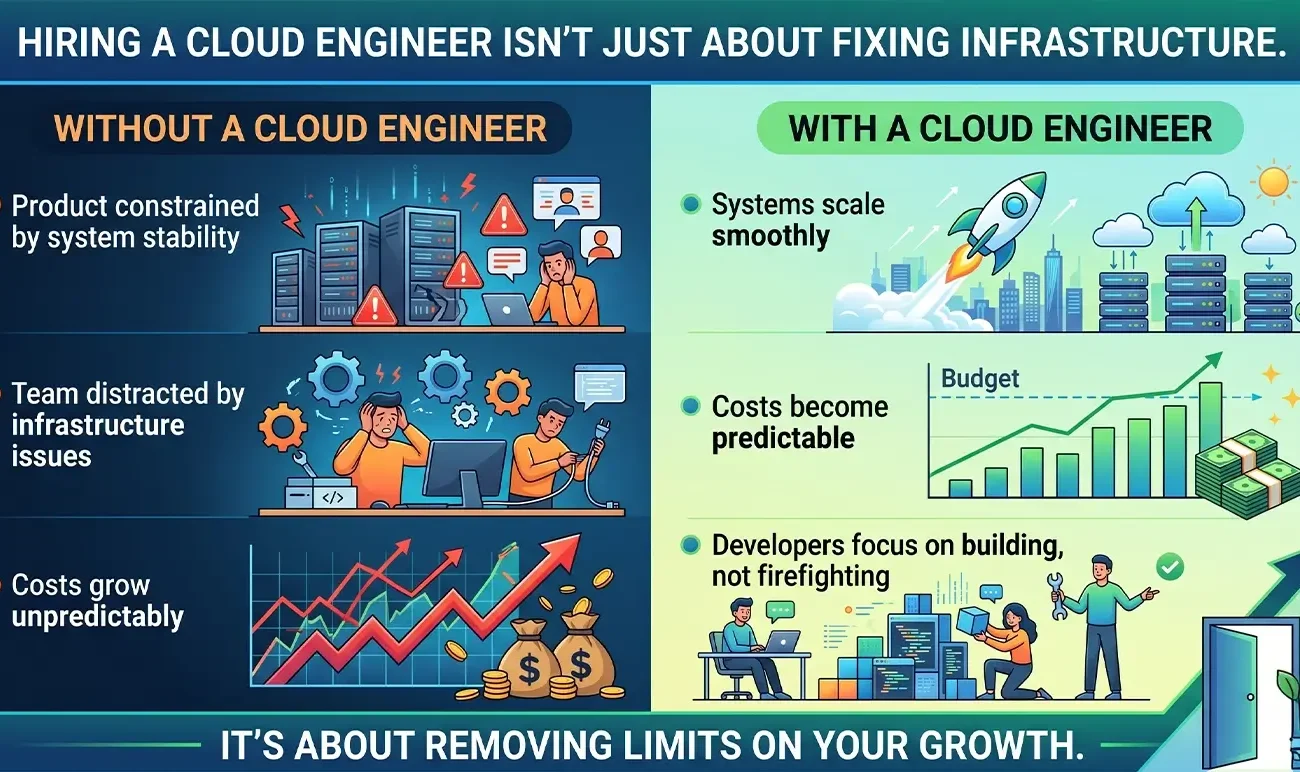
Hiring a cloud engineer isn’t just about fixing broken servers. It’s about removing the limits on your growth. Without a specialist, your product is constrained by system stability, your team is distracted by firefighting, and your costs grow unpredictably. With one, your systems scale smoothly, your costs become a predictable line item, and your developers can return to what they do best: building the future.
Final Thought
The best time to hire a cloud engineer is before infrastructure becomes your bottleneck—but after it stops being trivial. If your team is spending more time managing the cloud than building your product, the shift is already overdue.
At eDev, we specialize in helping startups and growing companies hire vetted cloud engineers who can design scalable infrastructure and optimize your performance. Don’t let infrastructure be the reason you slow down.

👉 Talk to our team and get a shortlist of vetted cloud engineers today.