
Modern engineering teams are no longer just divided into developers and operations. In 2026, cloud environments have become complex ecosystems involving microservices, containers, AI workloads, and distributed systems.
Yet many teams still struggle with a common issue:
a disconnect between development and DevOps.
Developers focus on shipping features. DevOps focuses on deployment and infrastructure. But who ensures that systems are optimized, scalable, and cost-efficient across both layers?
This is where cloud engineers play a critical role.
They act as the bridge between development and DevOps teams, ensuring that applications are not only deployed successfully—but also run efficiently at scale.

The Disconnect Between DevOps and Development
In many organizations, development and DevOps teams operate with different priorities, and while both functions are essential, the lack of alignment between them often creates inefficiencies.
Developers are primarily focused on building features, improving user experience, and shipping product updates as quickly as possible. Their success is often measured by how fast they can deliver new functionality and respond to product requirements.
On the other hand, DevOps teams are responsible for ensuring stability, reliability, and smooth deployment processes. They focus on maintaining infrastructure, managing CI/CD pipelines, and ensuring that applications run without downtime.
This difference in priorities can lead to several challenges.
For example, developers may push features that require additional infrastructure without fully understanding the cost or performance implications. DevOps teams, in turn, may need to adjust infrastructure after deployment, leading to delays or rework.
Over time, this creates friction between teams:
- features are delayed due to infrastructure constraints
- systems become over-provisioned to “play it safe”
- performance issues are addressed reactively instead of proactively
- cloud costs increase without clear ownership
In fast-growing startups, this disconnect becomes even more pronounced. As applications scale, infrastructure becomes more complex, and the lack of a unified approach to performance, cost, and architecture can slow down development velocity.
This is where a gap emerges, one that neither development nor DevOps fully owns.
Why DevOps Alone Isn’t Enough in 2026
DevOps revolutionized software development by bringing together development and operations through automation, continuous integration, and continuous delivery. It significantly improved deployment speed and reduced manual intervention.
However, the cloud landscape in 2026 has evolved far beyond what traditional DevOps practices were designed to handle.
Modern systems now involve:
- multi-cloud and hybrid environments
- containerized applications and Kubernetes orchestration
- AI and machine learning workloads requiring GPU optimization
- real-time scaling for global user bases
- complex cost structures tied to usage-based billing
While DevOps engineers are highly skilled in automating deployments and maintaining pipelines, their primary focus is still on delivery efficiency and system reliability.
What often falls outside their scope is deep infrastructure optimization.
For example, a DevOps engineer may ensure that an application scales automatically under increased load, but that doesn’t necessarily mean the system is scaling in a cost-efficient way. Similarly, they may set up monitoring tools, but not always optimize the underlying architecture for long-term performance.
This is where many companies begin to experience challenges such as:
- rapidly increasing cloud bills
- inefficient resource allocation
- underutilized or idle infrastructure
- lack of long-term architectural planning
As cloud environments grow more complex, the need for a specialized role focused on performance, cost efficiency, and infrastructure design becomes critical.
This is why many organizations are no longer relying solely on hiring DevOps engineers but are expanding their teams to include cloud engineers who bring a different layer of expertise.
Where Cloud Engineers Fit In
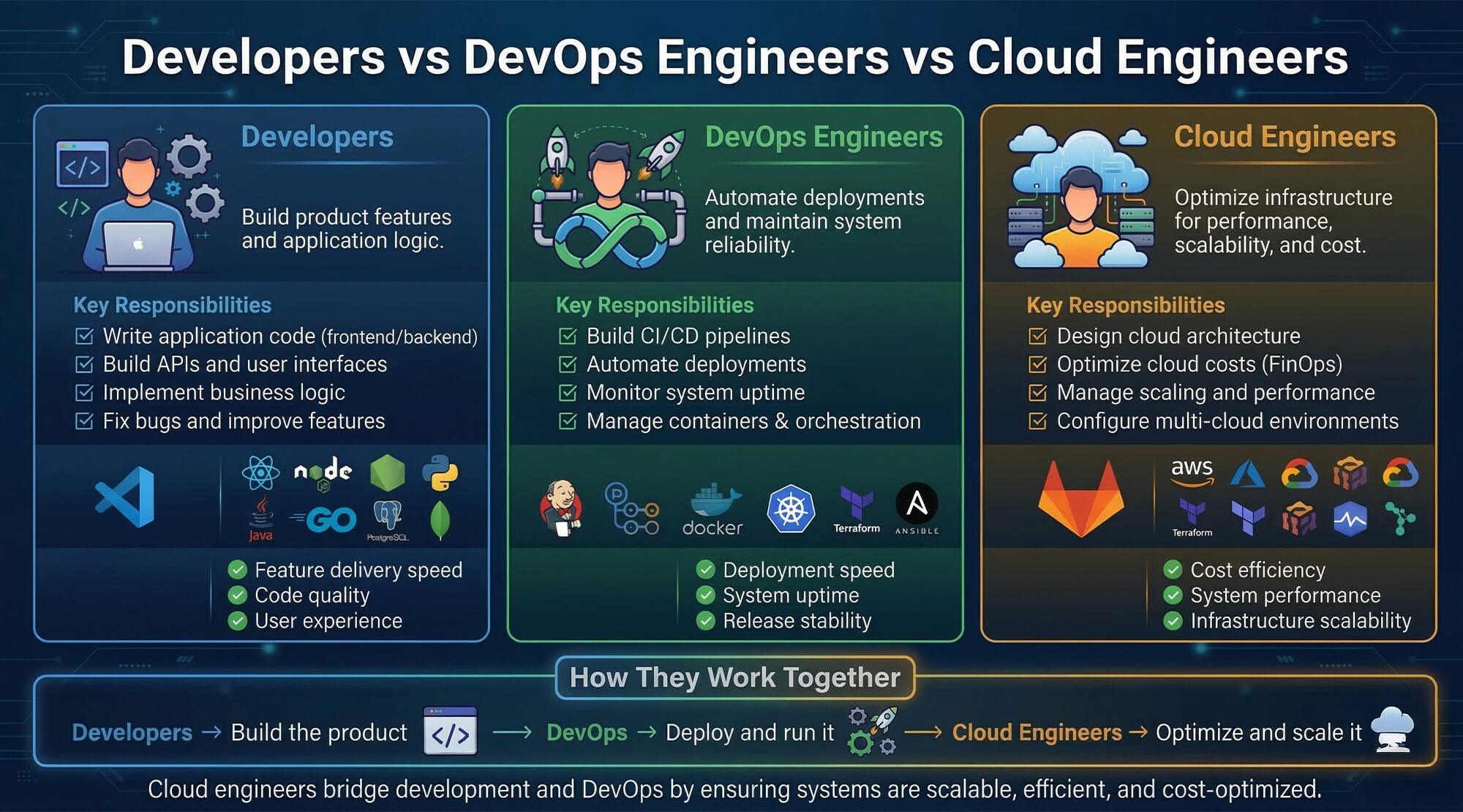
Cloud engineers step into this gap as the bridge between development and DevOps, bringing a holistic view of infrastructure, performance, and cost.
Unlike developers who focus on application logic, or DevOps engineers who focus on deployment and automation, cloud engineers focus on how systems are designed, optimized, and scaled over time.
They work closely with both teams to ensure that decisions made during development and deployment align with long-term infrastructure goals.
For example, when developers design a new feature, cloud engineers evaluate how it will impact system performance, scalability, and cost. They may recommend architectural changes, caching strategies, or different service configurations to improve efficiency.
Similarly, when DevOps teams set up deployment pipelines, cloud engineers ensure that the underlying infrastructure is optimized for those deployments. This includes selecting the right instance types, configuring auto-scaling policies, and designing efficient storage and networking solutions.
Their role extends across multiple layers:
Infrastructure Design and Architecture
Cloud engineers design systems that can scale efficiently as the application grows. This includes choosing between monolithic and microservices architectures, implementing containerization, and planning for multi-region deployments.
Performance Optimization
They continuously monitor system performance and identify bottlenecks. Instead of reacting to issues after they occur, cloud engineers proactively optimize systems to maintain high performance under varying workloads.
Cost Optimization (FinOps)
One of the most critical responsibilities of cloud engineers is managing cloud costs. They analyze usage patterns, eliminate waste, and implement strategies such as rightsizing, auto-scaling, and serverless architectures to reduce expenses.
Cross-Team Alignment
Perhaps their most important role is ensuring that development and DevOps teams are aligned. By acting as a shared point of expertise, cloud engineers help both teams make better decisions that balance speed, stability, and cost.
This integrated approach is why companies increasingly rely on cloud engineers to improve performance and cost efficiency across their infrastructure.
Real Impact on Engineering Teams
When cloud engineers bridge the gap between development and DevOps, the impact is immediate:
- faster and more stable deployments
- reduced cloud costs
- improved collaboration between teams
- better system reliability
- faster scaling of applications
Instead of working in silos, teams operate with a shared understanding of infrastructure and performance.
Cloud Engineer vs DevOps Engineer: What’s the Difference?
While the roles overlap, their core focus areas are different:
Feature | DevOps Engineer | Cloud Engineer |
Primary Focus | Deployment & automation | Infrastructure performance & cost |
Key Tools | CI/CD, Jenkins, GitOps | AWS, Azure, GCP, Terraform |
Responsibility | Release pipelines | System architecture & optimization |
Cost Optimization | Limited | Core responsibility |
Scaling Strategy | Deployment scaling | Infrastructure scaling |
In simple terms:
- DevOps ensures systems are deployed correctly
- Cloud engineers ensure systems are built and run efficiently
Together, they create a complete, high-performing cloud environment.
Why Startups Are Hiring Cloud Engineers Alongside DevOps
Startups scaling quickly often face challenges such as:
- rising cloud bills
- performance bottlenecks
- inefficient infrastructure
Hiring only DevOps engineers may solve deployment challenges, but not cost and architecture issues.
This is why many startups now hire dedicated cloud engineers alongside DevOps teams to:
- optimize infrastructure early
- avoid technical debt
- maintain cost control as they scale
Companies also prefer working with pre-vetted engineers who already have experience managing real-world cloud environments.
👉 Explore more insights on cloud and DevOps trends in our DevOps resources and cloud engineer insights.
In-House vs Remote Cloud Engineers
The shift toward remote engineering has made cloud roles even more efficient.
Remote cloud engineers often bring:
- experience across multiple global systems
- exposure to diverse infrastructure setups
- strong documentation and async communication skills
For companies looking to scale quickly, hiring remote specialists can provide faster access to high-quality talent.
👉 Explore options to hire cloud engineers for scalable infrastructure support.
Final Thoughts
As cloud environments become more complex, roles are evolving.
We’re also seeing transitions such as DevOps moving toward MLOps for AI-driven systems. If you’re exploring this shift, this guide on DevOps to MLOps transition provides additional context.
In this evolving landscape, cloud engineers play a central role in ensuring systems remain:
- scalable
- cost-efficient
- performance-driven
The gap between development and DevOps is not a failure of teams but a reflection of how complex modern systems have become.
Cloud engineers solve this challenge by aligning both sides around a single goal:
building systems that are fast, scalable, and cost-efficient.
As companies continue to scale their infrastructure, the role of cloud engineers will only become more critical.
For organizations looking to optimize performance while controlling cloud costs, bridging this gap is no longer optional but essential.