
One of the most critical stages for a startup is the moment when the engineering team needs to scale. Many startups begin with one technical founder or a single developer, but as the product gains traction, the need to expand the engineering team becomes urgent.
Scaling from 1 developer to 10 developers is not just a hiring challenge—it’s a strategic decision that affects product velocity, burn rate, and long-term technical architecture.
The problem is that traditional hiring approaches often slow startups down. Recruitment cycles can take months, local talent markets are expensive, and finding engineers with the right skills can be difficult.
To scale quickly without increasing costs dramatically, many startups now adopt a global hiring strategy, leveraging talent from cost-effective regions and working with platforms that simplify remote hiring.
In this guide, we’ll explore how fast-growing startups can scale their engineering teams efficiently from hiring the first few developers to building a distributed team of ten or more engineers. Many startups achieve this by hiring remote developers from global talent markets and partnering with platforms that simplify international hiring.
Why Scaling Engineering Teams Is Hard for Startups
When a startup reaches product-market fit, engineering demands increase rapidly. New features, performance optimization, infrastructure improvements, and bug fixes all require additional developer bandwidth.
However, scaling engineering teams comes with several challenges:
- Limited hiring budgets compared to large tech companies
- Intense competition for experienced developers
- Long recruitment cycles that slow product development
- Risk of hiring the wrong developers
- Operational complexity when hiring globally
According to industry hiring trends, the most successful startups focus on speed, flexibility, and global talent access when scaling their teams.
For example, many founders are rethinking how they approach recruitment. Instead of traditional hiring pipelines, they are adopting modern strategies similar to those discussed in developer recruitment trends for 2026, where the competition for specialized engineering talent continues to intensify.
Cost of Hiring Developers Locally vs Globally
One of the biggest reasons startups struggle to scale engineering teams is cost.
Hiring developers locally in major tech hubs can be extremely expensive.

For early-stage startups, hiring globally allows them to extend their runway while still accessing high-quality engineering talent.
This is why many SaaS companies are now building distributed teams using global developer talent.
Why Startups Are Hiring Developers from Global Talent Markets
The global developer ecosystem has expanded significantly in recent years. Countries across India, Eastern Europe, Latin America, Southeast Asia, and Japan now produce highly skilled software engineers capable of building world-class products.
Hiring from these regions offers several advantages:
Cost Efficiency
Developer salaries in regions like Silicon Valley or New York can exceed $150,000 annually. Hiring remote developers from emerging tech markets allows startups to reduce costs while still accessing top-tier talent.
Larger Talent Pools
Local hiring often limits startups to a small geographic talent pool. Global hiring dramatically expands the number of available developers.
Faster Hiring
Working with remote hiring platforms allows startups to hire vetted developers within days instead of months.
This approach is especially effective when startups partner with platforms that provide pre-screened engineers, similar to the strategy discussed in this guide on hiring vetted developers for faster scaling.
Step 1: Start with a Core Engineering Foundation
The first stage of scaling is building a small but capable engineering core.
When moving from 1 developer to 3–4 developers, startups should prioritize hiring engineers who can:
- work across multiple parts of the stack
- collaborate closely with founders
- contribute to architecture decisions
- adapt quickly as product requirements evolve
Many startups initially hire full-stack developers or versatile engineers who can contribute across backend, frontend, and infrastructure tasks.
Understanding the difference between hiring freelancers and dedicated developers is important at this stage. If you’re evaluating different options, this guide on freelance vs dedicated full-stack developers explains how each hiring model impacts long-term remote teams.
Step 2: Use Offshore or Distributed Development Models
Once the core team is established, startups can scale faster by adopting distributed development strategies.
Many SaaS companies build engineering teams using offshore development models, which allow them to access global talent while maintaining product velocity.
Common offshore development models include:
- Dedicated remote developers
- Managed development teams
- Hybrid in-house and remote teams
- Employer of Record (EOR) hiring
- Contractor-based hiring
Each model offers different levels of flexibility and cost efficiency. If you’re evaluating these approaches, you can explore the top offshore development models used by SaaS companies.
Step 3: Hire from Cost-Effective Tech Talent Regions
One of the smartest ways to scale quickly is by hiring developers from regions that offer high-quality engineering talent at competitive costs.
Some of the most popular regions include:
- India
- Latin America
- Eastern Europe
- Southeast Asia
- Japan
- Ireland
These regions have strong technical education ecosystems and large developer communities.
Hiring from these locations allows global teams for startups to:
- reduce engineering costs
- scale teams quickly
- maintain productivity across time zones
- build 24/7 development cycles
Challenges of Hiring Developers Without a Hiring Partner
Many startups attempt to hire developers independently through job boards or freelance marketplaces. However, this approach can introduce several risks:
- Difficulty verifying developer skills
- Time spent reviewing hundreds of resumes
- Managing international contracts and compliance
- Onboarding remote engineers effectively
- Replacing underperforming developers
These challenges often slow down product development.
This is why many startups choose to work with developer hiring platforms that provide pre-vetted developers and operational support.
Step 4: Partner with the Right Developer Hiring Platform
Scaling engineering teams quickly is much easier when startups work with platforms that specialize in remote developer hiring.
Instead of managing recruitment pipelines internally, startups can partner with platforms that provide:
- pre-vetted developers
- global talent pools
- flexible hiring models
- compliance support
- fast onboarding
Choosing the right hiring platform is critical. If you’re evaluating different platforms, this comparison of Lemon.io vs Toptal vs eDev explains how developer hiring platforms differ in terms of flexibility, pricing, and global hiring capabilities.
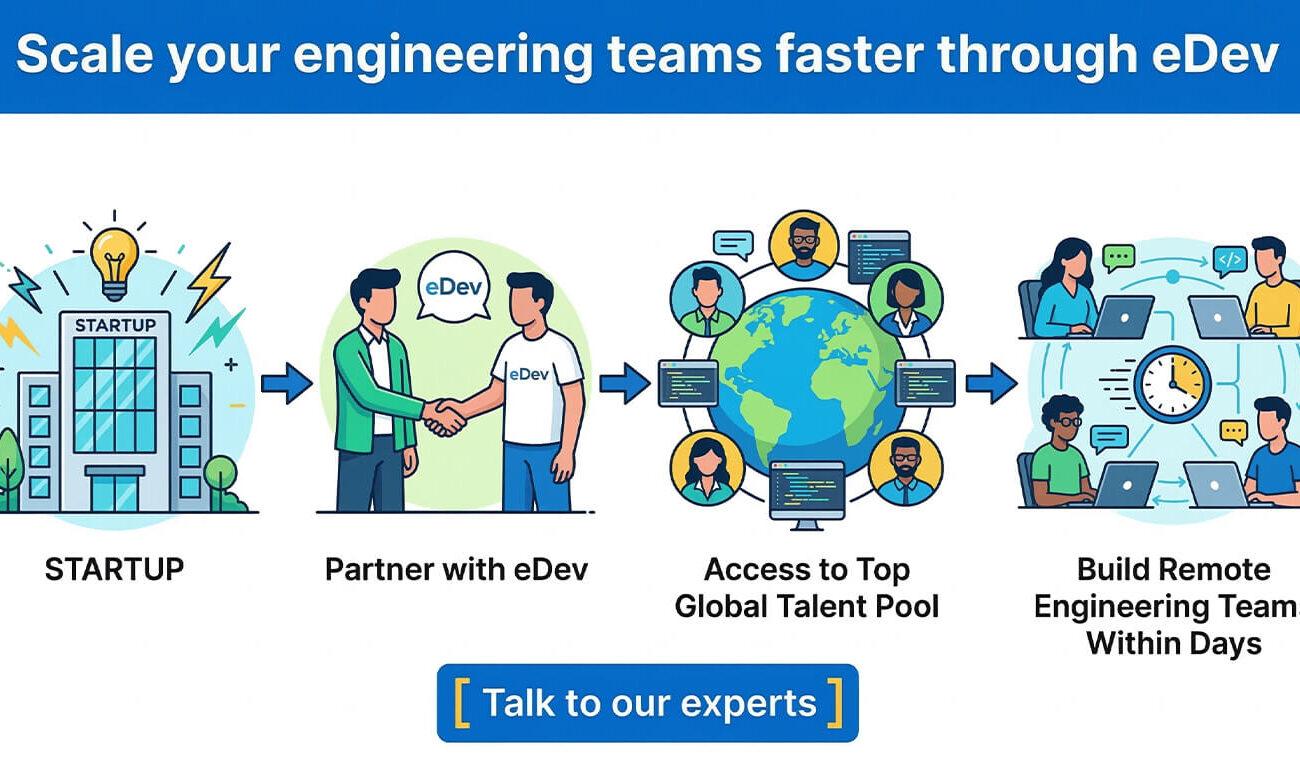
Platforms like eDev simplify the hiring process by allowing companies to:
- Hire dedicated remote developers quickly
- scale engineering teams up or down
- transition contractors into full-time remote employees
- avoid global hiring compliance challenges
Step 5: Focus on Fast and Efficient Onboarding
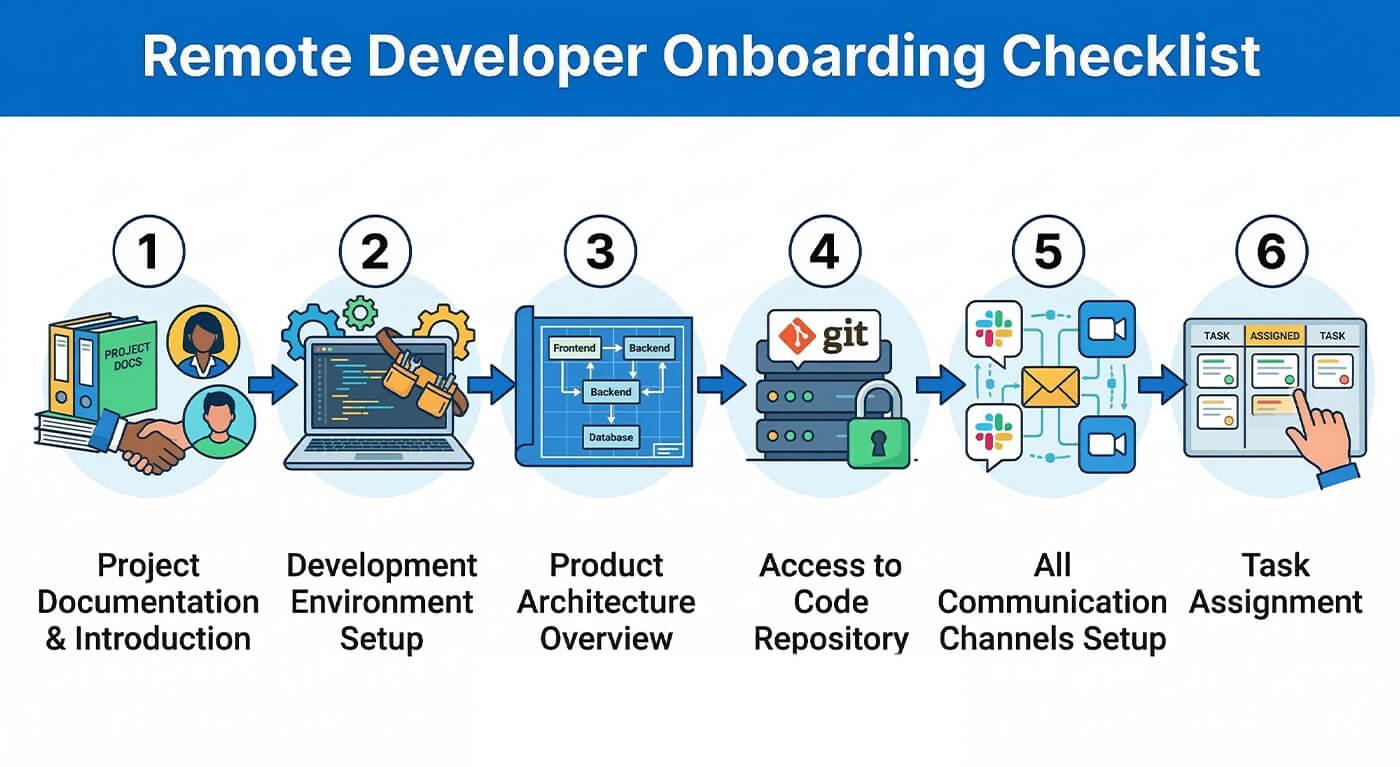
Hiring developers is only half the challenge. Proper onboarding is essential to ensure new engineers become productive quickly.
Successful startups invest in:
- structured onboarding processes
- clear documentation
- codebase walkthroughs
- defined development workflows
Efficient onboarding dramatically improves developer productivity and reduces ramp-up time. For example, companies that follow structured onboarding practices similar to those described by experts on how to onboard remote developers faster can integrate new engineers much more efficiently.
Step 6: Build Specialized Roles as the Team Grows
As the engineering team approaches 8–10 developers, specialization becomes more important.
Instead of generalists, startups can hire engineers for specific roles such as: Frontend developers, Backend developers, DevOps engineers, Mobile developers, QA engineers, etc.
Specialized roles improve product stability, performance, and scalability.
However, hiring these roles individually through traditional recruitment channels can take months. Partnering with a developer hiring platform allows startups to fill specialized positions faster.
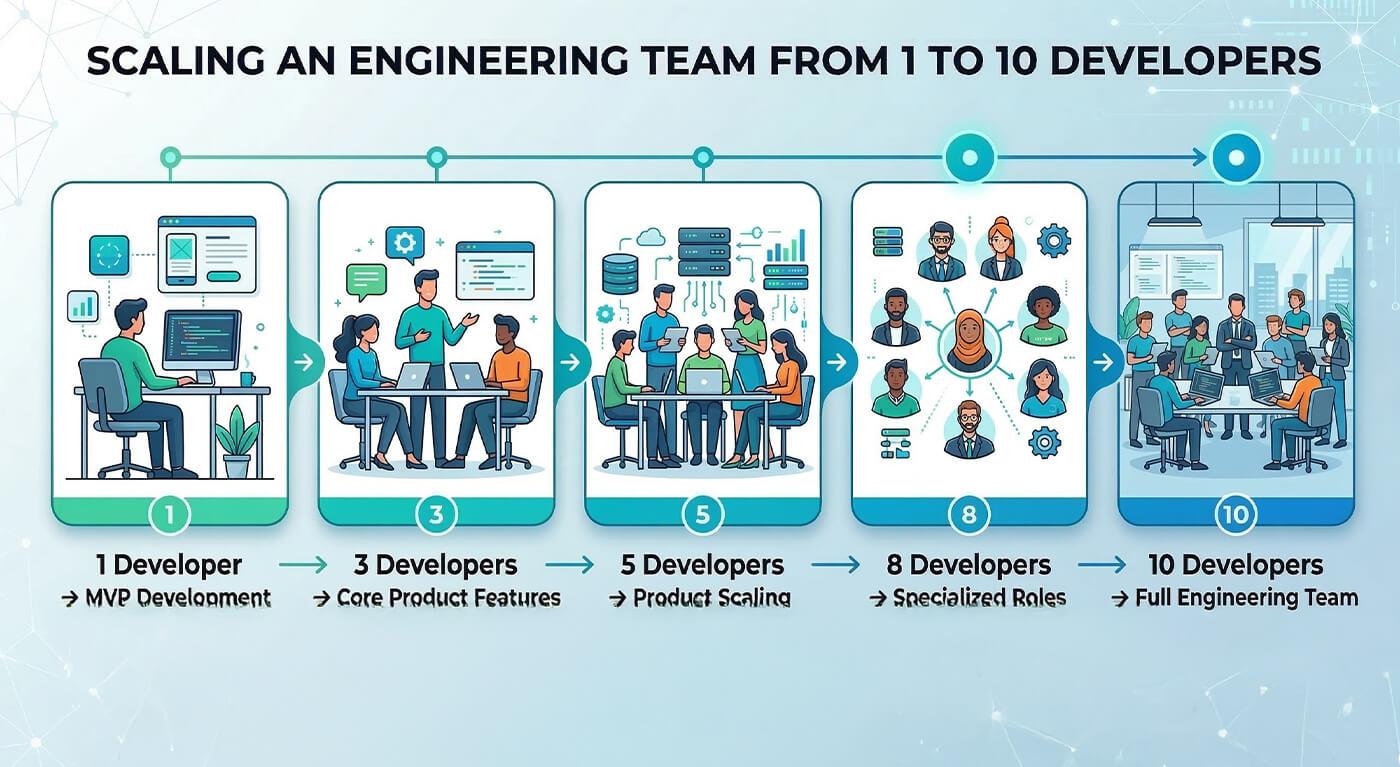
Typical Engineering Team Structure When Scaling from 1 to 10 Developers
As startups grow, engineering teams naturally evolve into specialized roles.
Stage 1: 1–2 Developers
- Full-stack developers
- Founders writing production code
Stage 2: 3–5 Developers
- Frontend developer
- Backend developer
- Full-stack developer
Stage 3: 6–10 Developers
- Backend engineers
- Frontend specialists
- DevOps engineer
- QA engineer
- Platform engineers
Specialized roles help startups improve performance, stability, and development velocity.
Why Fast-Growing Startups Choose eDev
For startups scaling engineering teams quickly, speed and flexibility are critical.
Platforms like eDev provide several advantages for companies looking to scale from 1 to 10 developers:
Access to Global Developer Talent
Startups can hire developers from multiple global regions without being limited to local hiring markets.
Flexible Hiring Models
Companies can hire developers as:
Startups can hire dedicated developers starting at $30 per hour, paying only for hours worked while scaling their teams quickly.
Startups can also hire developers as full-time remote employees without setting up international legal entities.
EOR services start at $399 per employee per month and include:
- payroll & benefits management
- HR services
- compliance support
- IT administration
- equipment provisioning
Companies can start with contractors and later transition developers into full-time employees, giving startups the flexibility to scale teams as they grow without risks or penalties.
Transparent Pricing
Hiring developers through eDev provides cost predictability without hidden platform fees.
Faster Hiring
Startups can typically receive matched developer profiles within 48 hours.
Startup Founder Checklist for Scaling Engineering Teams
Before expanding your engineering team, founders should consider the following:
✔ Define product roadmap
✔ Identify required tech stack
✔ Decide between contractor vs full-time hiring
✔ Choose global hiring regions
✔ Partner with a developer hiring platform
✔ Create an onboarding process
This checklist helps startups scale engineering teams without introducing operational complexity.
Final Thoughts
Scaling an engineering team from 1 developer to 10 developers is one of the most important milestones for a startup.
Companies that rely solely on traditional hiring methods often struggle with slow recruitment cycles and high costs. In contrast, startups that adopt global hiring strategies and partner with specialized developer platforms can scale much faster.
By hiring from cost-effective regions, using distributed development models, and partnering with platforms like eDev, startups can build high-performing engineering teams without unnecessary hiring complexity.
The future of startup hiring is global, and the companies that embrace this approach will have a significant advantage in building innovative products faster.