
Scaling a SaaS company in 2026 is a race against both time and capital. With the global SaaS market projected to grow at a CAGR of 23% through 2029, reaching a staggering valuation increase of over $560 billion (Technavio, 2026), the pressure to ship features faster than the competition has never been higher.
However, the “local-only” hiring model is increasingly becoming a bottleneck. Between rising talent scarcity and the high overhead of domestic operations, CTOs are turning to global engineering centers to maintain their edge. But “offshoring” is no longer a monolith. The strategy you choose, whether it’s augmenting a squad or building a full-scale center, can be the difference between a seamless launch and a technical debt nightmare.
In this guide, we break down the Top 7 Offshore Development Models specifically for SaaS leaders and show you how to choose the one that aligns with your 2026 roadmap.
What is an Offshore Development Model?
An offshore development model is a structured framework for partnering with external engineering talent located in a different geographical region (typically one with a lower cost of living or a denser talent pool).
Unlike simple “outsourcing,” which is often transaction-based, a modern offshore model focuses on integration. It defines how the remote teams are managed, who owns the infrastructure, how the billing is structured (hourly vs. fixed), and the level of cultural and operational alignment with your core team.
When Do Companies Opt for an Offshore Model?
Most SaaS companies hit a “pivot point” where local resources are no longer sustainable. You should consider shifting gears when:
- Local Talent Scarcity: You need niche skills (like GenAI orchestration or Rust) that are already “tapped out” in your local hub.
- The 24/7 Mandate: You need “Follow-the-Sun” operations to provide round-the-clock support and continuous deployment.
- Burn Rate Optimization: You need to extend your runway without compromising on technical depth. According to Accelerance’s 2026 Global Sourcing Report, companies that move to a structured Offshore Development Model (ODM) typically realize 40–70% cost optimization on senior engineering roles compared to hiring in Tier-1 US tech hubs.
- Rapid Scaling: You’ve secured a round of funding and need to ramp up from 2 to 20 developers in weeks, not quarters.
The shift toward offshore centers is no longer a fringe strategy but a core pillar of SaaS growth. Recent data from The Business Research Company indicates that the global offshore software development market is projected to grow to $204.32 billion by 2026, a 14.6% increase driven specifically by the demand for scalable, dedicated engineering hubs that integrate into the parent company’s CI/CD pipelines.
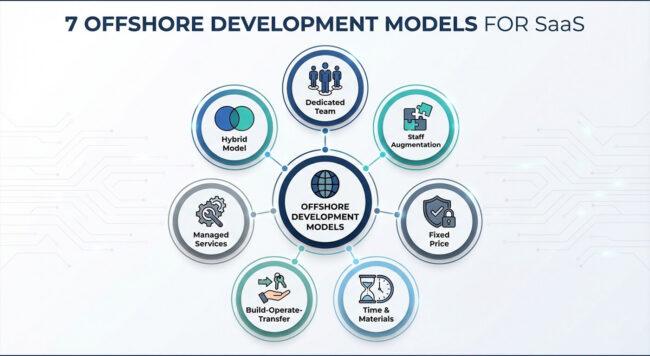
7 Offshore Development Models for SaaS Companies
1. The Dedicated Development Team (DDT)
In this model, the provider assembles a team that works exclusively on your product. They function as a remote extension of your office, following your internal processes, using your Slack channels, and reporting to your CTO.
- Benefits: High cultural alignment, deep product knowledge over time, and consistent velocity.
- When to Use: Long-term projects with an evolving roadmap where the developers need to understand the “Why” behind the code.
2. Staff Augmentation
This is the “plug-and-play” model. You keep your internal management structure and “borrow” specific specialists to fill gaps in your existing team.
- Benefits: Extreme flexibility. You can add a QA engineer for one sprint and a DevOps specialist for the next.
- When to Use: When you have a strong in-house team but lack specific niche expertise or need extra “muscle” to hit a deadline.
3. Project-Based (Fixed Price) Outsourcing Model
You hand over a fully defined set of requirements to the offshore partner. They provide a quote and a timeline to deliver the finished product.
- Benefits: Financial predictability. The risk of overruns sits primarily with the vendor.
- When to Use: Low-complexity projects with a static “Definition of Done,” such as a simple landing page or a standard internal tool.
4. Time and Materials (T&M)
You pay for the actual hours worked by the developers. It is a flexible, consumption-based model that allows for shifting priorities.
- Benefits: Total agility. You can change direction mid-stream without renegotiating a massive contract.
- When to Use: Early-stage R&D where the final product vision hasn’t fully crystallized.
5. Build-Operate-Transfer (BOT)
The offshore partner builds a dedicated center for you, manages it for a set period (usually 1–3 years), and then transfers full ownership, including the legal entity and the physical assets, to you.
- Benefits: Minimal upfront risk for you to establish a legal footprint in a new country.
- When to Use: Large-scale enterprises looking to eventually own their own international satellite campus.
6. Managed Services (Product Engineering)
The vendor takes full ownership of a specific business function (e.g., your entire Mobile App or your Security Operations Center) or your entire remote team. You manage the outcomes, they manage the people and the “How.”
- Benefits: Allows your core team to stay hyper-focused on the primary web platform or business strategy.
- When to Use: Secondary product lines or legacy maintenance.
7. The Hybrid Model
A combination of models, typically keeping a core of “Dedicated Developers” for the roadmap while using “Staff Augmentation” for specialized, short-term spikes.
- Benefits: Balances stability with the ability to handle unexpected technical hurdles.
- When to Use: Mature SaaS companies with multiple complex workstreams.
Many companies confuse offshore delivery models with employment structures.
Here’s the key distinction: Traditional offshore models, such as staff augmentation, dedicated teams, or offshore development centers, define how work is delivered and managed.
But they do not solve the biggest global hiring challenge: legal employment, payroll, compliance, and cross-border risk.
That’s where eDev stands apart.
The eDev Difference: Risk-Free Global Scaling
At eDev, we realized that traditional outsourcing models often leave SaaS founders with a choice between speed and stability. We’ve built a model that offers both by removing the “Administrative Drag” of international hiring.
eDev combines:
- The flexibility of staff augmentation
- The control of a dedicated team model
- The scalability of offshore development
- And the compliance backbone of an Employer of Record (EOR) structure
EOR is not a delivery model; it’s a legal employment layer that enables global
without entity setup, payroll complexity, or compliance risk.
With eDev:
- You control the engineering output
- The developer works as an extension of your team
- We handle contracts, payroll, tax compliance, and cross-border regulations
This means you get the operational control of offshore hiring without the legal overhead.
1. The EOR (Employer of Record) Model
Building a remote team shouldn’t require you to learn the labor laws of five different countries. Through the EOR service, eDev handles the legalities, payroll, compliance, and benefits for your remote developers. This allows you to launch a fully remote team to develop your product while we take on the operational risks.
2. Dedicated Developers (Hourly Flexibility)
For teams that need to scale without the “permanent headcount” lock-in, eDev provides Dedicated Developers who integrate into your team seamlessly.
- Pay-per-hour: No massive upfront fees or hidden retainers.
- Seamless Integration: Our developers work in your time zone, use your tools, and adopt your culture from day one.
Case Study Example: Building a Global Mentorship & Learning Platform
To see the eDev model in action, look at how we helped a client build a scalable, global mentorship platform. The goal was to connect students with expert mentors across professional and athletic domains through secure, real-time interactions.
The Challenge
The platform required a complex mix of real-time video, secure messaging, and automated scheduling—all while needing to scale worldwide. The client needed a senior-level team that could handle a sophisticated tech stack without the 6-month delay of local hiring.
Using our Employer of Record (EOR) offshore model, we deployed a dedicated team that took over the end-to-end development: Frontend & UX, Architecture, Complex Integrations, and Serverless Efficiency.
The Outcome
The platform now successfully supports a global user base with seamless scheduling and secure transactions. By leveraging our dedicated developers, the client bypassed the administrative nightmare of global hiring and launched a production-ready, cloud-enabled platform that is ready to scale their ecosystem confidently. Read the full Case Study Here
Choose Your Engine for 2026
The “right” model depends on your current stage. If you are a seed-stage founder, the eDev EOR model for MVP development and then the full product protects your focus. If you are a scaling CTO, our Dedicated Developer model provides the surgical precision you need to hit your roadmap without the “bloat” of traditional local hiring.
In a global economy, your competitive advantage is no longer just your code; it’s the speed and efficiency of the team writing it.