
In 2026, the cloud is no longer a “storage space” but the nervous system of modern business. However, as cloud ecosystems grow more complex with AI-integrated workflows and edge computing, many organizations find themselves facing “Bill Shock.”
While the cloud offers infinite scalability, it also offers infinite ways to waste money. This is where the Cloud Engineer transitions from a technical luxury to a financial necessity. They are the architects who ensure your digital infrastructure isn’t just running, but running at peak performance with a lean budget.

What Do Cloud Engineers Actually Do?
In 2026, a Cloud Engineer’s role has evolved beyond simple server maintenance. They are hybrids of developers, system administrators, and financial analysts (often referred to as FinOps). Their core responsibilities include:
- Infrastructure as Code (IaC): Using tools like Terraform or Pulumi to automate the setup of environments, ensuring consistency and eliminating human error.
- Cloud Architecture Design: Choosing between multi-cloud, hybrid, or serverless models based on the specific needs of the application.
- Security & Compliance: Implementing “Zero Trust” architectures and ensuring data residency requirements are met across global borders.
- Observability & Monitoring: Setting up real-time dashboards to track system health and performance bottlenecks before they affect the end-user.
When is the Right Time to Hire a Cloud Engineer?
Most companies wait until something breaks or the AWS bill triples to look for help. To stay ahead, you should consider hiring a Cloud Engineer if:
- You’re Scaling Globally: If your user base is expanding across continents, you need edge computing and CDN strategies to maintain low latency.
- Cloud Waste is Visible: According to the Flexera 2025 State of the Cloud Report, organizations estimate that 30% of their cloud spend is wasted due to over-provisioning and idle resources.
- Deployments are Manual: If your developers are manually configuring servers instead of shipping code, your “time-to-market” is suffering.
- Security Debt is Accumulating: If you lack a centralized strategy for IAM (Identity and Access Management) and encryption, you are a high-risk target for 2026’s sophisticated cyber threats.

How Cloud Engineers Optimize Performance and Cost
The “Speed vs. Cost” dilemma is a myth in cloud computing. Often, the most performant systems are the most cost-efficient because they utilize resources exactly when needed.
1. Rightsizing and Auto-scaling
Cloud Engineers analyze historical data to ensure you aren’t paying for an “Extra Large” instance when a “Medium” will do. They implement auto-scaling groups that “breath” with your traffic, expanding during peak hours and shrinking to near-zero during downtime.
2. Transitioning to Serverless and Containerization
By moving workloads to serverless (like AWS Lambda) or orchestrated containers (Kubernetes), you stop paying for idle “compute time.” You only pay for the exact milliseconds your code is running.
3. Strategic Data Tiering
Not all data needs to be “hot” (instantly accessible). Cloud Engineers set up automated lifecycle policies that move older data to “cold” or “glacier” storage, which can be up to 90% cheaper than standard storage.
4. Graviton and Spot Instances
A skilled engineer will leverage ARM-based processors (like AWS Graviton) which offer significantly better price-performance ratios, and “Spot Instances” for non-critical background tasks to save up to 70-90% on compute costs.
In-house vs. Remote: The 2026 Efficiency Battle
The debate between in-house and remote cloud engineers has shifted. In 2026, the Remote/Global model is winning on both effectiveness and cost.
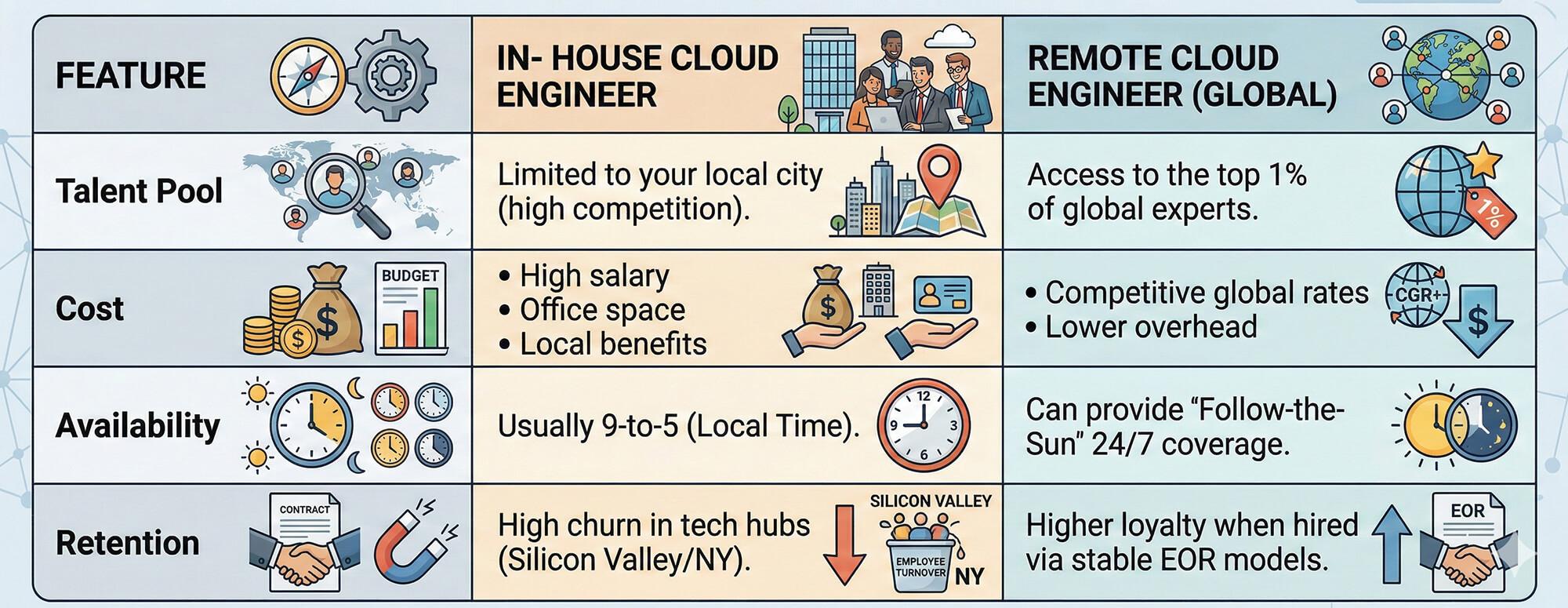
The Verdict: For cloud engineering (a role that is digital by nature) a remote specialist is often more effective. Because they are used to working across time zones, their documentation and asynchronous communication skills are usually superior, which is vital for maintaining a complex cloud infrastructure.
How to Hire the Best Cloud Engineers
Hiring cloud engineers in 2026 requires more than a keyword search. You need to verify hands-on problem-solving skills and financial literacy.
- Look for Multi-Cloud Literacy: The best engineers aren’t just AWS experts; they understand how to leverage GCP for AI or Azure for enterprise integration.
- Use Specialized Platforms: Avoid the “noise” of general job boards. Platforms like eDev specialize in pre-vetted, high-tier technical talent.
The eDev Advantage: At eDev, hiring cloud engineers isn’t just about matching resumes to job descriptions. We combine structured AI-based profile screening with hands-on human evaluation to identify engineers who have worked on infrastructures similar in scale, complexity, and industry context to yours. That means you’re not just hiring someone who “knows AWS” but hiring someone who has optimized environments, managed live workloads, and supported growing teams in real-world scenarios.
Beyond sourcing, eDev supports companies through two flexible hiring models: dedicated developers on a pay-by-the-hour basis or full-time employees engaged through our Employer of Record (EOR) model. For global hires, the EOR structure ensures compliant employment, payroll management, and administrative oversight in the developer’s local jurisdiction.
We also provide a centralized platform to manage remote developers, including visibility into assignments and operational workflows, so leadership teams can stay focused on performance, cost control, and product outcomes, not cross-border hiring complexities.