
What is the ultimate fear of the non-technical founder? Writing a six-figure check to a developer whose code you can’t read, and whose work you can’t see. In 2026, the stakes are higher than ever, but so is your opportunity.
If you are a visionary founder without a technical background, your challenge isn’t finding talent; it’s vetting it. The old methods were risky. The new method is strategic: partnering with a platform to hire expert developers places a human technical expert in your corner.
High Stakes and The Fear Factor
You have the product vision, the market knowledge, and the business acumen. What you lack is the deep technical language to separate a high-impact engineering genius from a highly articulate fraud.
This dilemma is compounded by necessity: you must hire globally. You can no longer afford to limit your search to expensive local markets where highly specialized talent (in areas like MLOps or Generative AI integration) is scarce. Global hiring is mandatory for survival, but it feels like jumping into a well without a map.
The Old Rules Are Broken: The Hiring Pitfalls
The shift in hiring is best understood by looking at the monumental risks non-technical founders took just a decade ago.
The Risky Bets Non-Technical Founders Used to Make
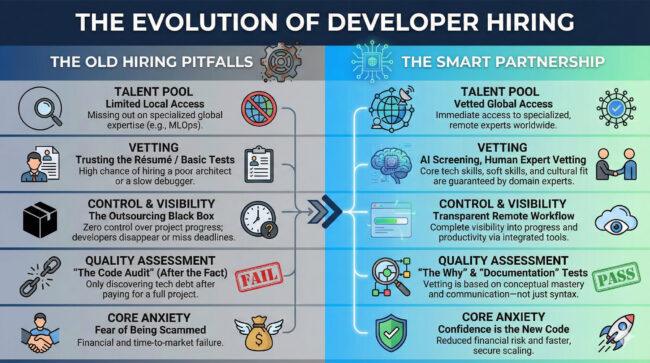
How non-technical founders hired a decade ago involved relying on blind faith, expensive (and often biased) local recruiters, or the infamous traditional outsourcing model. This model was a black box defined by two things:
- Zero Visibility: You had little to no control over the project progress. You only saw the final output, leading to delayed launches and painful rework.
- Lack of Accountability: When a project went sideways, finger-pointing was common, and you were left with a mess of tech debt and a wasted budget.
The True Cost of a Bad Code Audit
The cost of a bad developer isn’t just their salary; it’s the multi-million-dollar risk of poor architecture. A single developer mistake—a fundamental flaw in how the database connects to the server—can hamstring your product for years, making future scaling impossible and driving up maintenance costs exponentially. This is the risk you assumed when you couldn’t read the code yourself.
The Smart Partnership: AI Screening, Human Vetting (The eDev Model)
The good news is that technology has provided a framework to mitigate this risk, but it requires understanding the crucial distinction between what a machine can do and what a human must do. (For more on the strategic direction of tech hiring, see our deep dive on Developer Acquisition in 2026).
The Machine’s Role: Where AI Excels in Recruitment
Artificial intelligence is a game-changer for volume and velocity in the hiring process:
- Sourcing: AI can scan millions of global profiles to find candidates with niche skills, saving weeks of manual searching.
- Initial Screening: Automated tools quickly score résumés for keywords and experience.
- Basic Coding Tests: AI can run candidates through standardized tests that check for correct syntax, algorithmic knowledge, and basic security flaws. AI handles the grunt work.
The Human Imperative: Why You Need a Technical Partner
This is where the machine stops, and the expert must take over. AI lacks the empathy and psychological skills to:
- Judge cultural fit in a nuanced remote setting.
- Assess past accomplishments and core technical capabilities through detailed behavioral questioning.
- Gauge long-term motivation, integrity, and potential for leadership.
Only 26% of job candidates trust AI to evaluate them fairly, according to a Gartner survey in July 2025, highlighting the critical trust gap human experts must bridge.
eDev can step in as the technical partner. Our in-house domain experts, who have built and scaled similar products, conduct the deep-dive technical interviews. They assess architectural foresight, code hygiene, and project management philosophy. This human-centric vetting is the confidence layer you need.
Today, non-tech leaders hiring through eDev gain complete visibility and control over day-to-day tasks, project progress, and the productivity of their dedicated remote developers, eliminating the black box risk of past outsourcing.
The Non-Coder’s Checklist: Assessing Talent Without Code
Once eDev, as your technical partner, validates a candidate’s core skills, your final interview should focus entirely on conceptual mastery and communication. Use these three non-technical questions to reveal a developer’s true value:
1. The “Why” Test: Assessing Architecture and Decision-Making
Ask: “Why did you choose that specific framework/solution over the other three popular options?”
- What it reveals: Critical thinking, knowledge of trade-offs, and foresight. A great developer understands that every decision is a compromise and can articulate the future technical debt they avoided (or incurred) with their choice.
2. The “Documentation” Test: Assessing Communication and Ownership
Ask the candidate to explain a complex design decision in a written, easy-to-understand document (e.g., a simple API diagram or a user flow).
- What it reveals: Communication is key in a remote team. This test reveals their ability to be autonomous, transfer knowledge to you (the founder), and manage complexity—all vital remote skills.
3. The “Error-Handling” Test: Assessing Integrity
Ask: “Describe your biggest coding mistake and the process you used to fix it.”
- What it reveals: Honesty, humility, and their debugging process. The best developers own their mistakes and have a mature, systematic approach to preventing recurrence.
Beyond Hiring: Building Trust and Culture Remotely
Tech Hiring is only half the battle. Your job is to enable your global asset.
Defining ‘Remote Fit’: Looking for Autonomy and Ownership
The best remote developers don’t need supervision; they need context. Look for candidates who proactively communicate project risks, propose solutions before problems escalate, and manage their own time without constant reminders. Screen for self-starters.
The ‘Rituals’ of Trust: Async First
Move away from daily, mandatory, time-zone-clashing check-ins. Embrace asynchronous workflows where status updates are communicated via project management tools or short video updates (Loom/similar). This maximizes the developer’s deep focus time and respects their time zone, which is critical for long-term retention.
Confidence is the New Code
The new developer talent war is not won by the non-technical founder who learns to code; it’s won by the one who learns to leverage the right partnership.
You no longer need a technical co-founder whose primary role is vetting. You need a strategic partner.
By letting AI handle the volume, and eDev’s experts handle the human-centric technical vetting, you gain full confidence in the quality of your hire. This frees you to focus on your ultimate role: defining the vision and scaling your company.
Partner with eDev to access the specialized global talent pool, vet them with confidence, and build the product you envisioned.