
In the modern software economy, speed isn’t just a metric for your code—it’s a metric for your talent acquisition. When a world-class developer joins your team, the clock starts ticking immediately. Every day spent in “onboarding limbo” is a day of depreciating ROI and mounting frustration for both the talent and the organization.
Traditional onboarding was built for the office: a desk, a handshake, and a physical walkthrough. In a remote-first, globalized world, that model is broken. To achieve Zero Friction, onboarding must be treated like a high-performance deployment pipeline: automated, documented, and outcome-oriented.
According to research by Glassdoor, organizations with a strong onboarding process improve new hire retention by 82% and productivity by over 70%. Furthermore, a study by BambooHR: The Onboarding Effect found that employees who have a positive onboarding experience are 18x more likely to feel highly committed to their company.
I. Pre-boarding: Eliminating the “Administrative Drag”
Zero-friction onboarding begins the moment the offer is accepted, not on the start date. High-performing teams separate administrative onboarding (the “plumbing”) from cultural/technical onboarding (the “work”).
1. Automating Global Compliance and Payroll
The biggest source of friction in remote hiring is the complexity of international labor laws, tax withholding, and local compliance. If your HR team is manually navigating the labor codes of five different countries, your onboarding will never be fast.
By leveraging hiring platforms like eDev, organizations offload the entire “Administrative Drag.” eDev handles:
- Localized Contracts: Legally vetted agreements that comply with the developer’s specific jurisdiction.
- Global Payroll & Taxes: Automated payments that account for local exchange rates and tax requirements.
- Compliance Safeguards: Ensuring IP protection and data privacy across borders.
2. Hardware and Software Provisioning
A developer cannot be productive without the right tools. High-performing teams use Automated Asset Management.
- Hardware Logistics: Laptops and peripherals should arrive before the start date.
Identity Access Management (IAM): Use tools like Okta or Google Workspace to ensure that one click grants access to Slack, GitHub, Jira, and AWS.

II. Technical Immersion: The Handshake Between Code and Culture
Once the plumbing is handled, the focus shifts to the codebase. The goal is Time to First Commit.
1. The “ReadMe” First Culture
Your documentation should be so robust that a senior developer can set up their environment without asking a single question in Slack. This includes:
- The “Golden Path” Setup: A step-by-step guide to cloning the repo, installing dependencies, and running the local server.
- Contribution Guidelines: How does the team handle branching, naming conventions, and pull requests?
- Architecture Map: A high-level visual guide to the system.
2. The “Buddy” System (Technical Peer)
Documentation is essential, but it doesn’t replace human context. Every new developer should be assigned a “Buddy”, not a manager, but a peer who can answer the “low-stakes” questions. This reduces the psychological barrier to entry and builds immediate social capital.
III. The Unified Management Infrastructure
Zero friction is not just about the first week; it’s about the ongoing management infrastructure. This is where many tech companies fail. They have great developer recruitment but poor long-term resource management.
High-performing remote teams don’t juggle five different apps for time-tracking, performance, and leave. They use a unified Employee Dashboard via their hiring partner.
- Performance Management: Setting clear, objective KPIs within the eDev platform allows developers to see how they are being measured, removing the “remote anxiety” of not knowing if they are doing enough.
- Resource & Team Management: Having a single source of truth for team availability, specialized skills, and project allocation.
- Elastic Scaling: Project needs change. A zero-friction model allows a company to transition developers between Contract and EOR (Employer of Record ) models for global expansion, ensuring the team size matches the roadmap velocity without a complete rehiring process.
IV. The Zero-Friction First Week Checklist
To move from “New Hire” to “Contributor” in 120 hours, follow this high-intensity, zero-friction schedule.
Day 1: Connection & Access
- [ ] The Vision Brief: A 15-minute 1-on-1 to discuss the “Why” behind the product.
- [ ] Access Audit: Verify all credentials (GitHub, Slack, Jira, Cloud consoles) are active.
- [ ] Buddy Introduction: Confirm the developer knows their go-to peer for technical hurdles.
Day 2: The “Small Win” Commit
- [ ] Local Environment Setup: Developer completes the “ReadMe” setup.
- [ ] The First Ticket: Assign a “Good First Issue”, a bug fix or a minor UI tweak.
- [ ] Goal: A pushed commit to a staging environment by the end of the day.
Day 3: Deep Dive & Workflow Integration
- [ ] Architecture Walkthrough: A recorded video session explaining data flow and edge cases.
- [ ] Code Review Rituals: Participate in their first PR review to learn the team’s “Code Language.”
Day 4: Tooling & Administrative Mastery
- [ ] Dashboard Sync: Train the developer on using the platform for time-tracking, leave management, and reporting.
- [ ] Performance Alignment: Review the specific KPIs and output expectations for the first 30 days.
Day 5: Momentum Check & Feedback
- [ ] Retrospective: Ask the developer, “Where was the friction this week?”
- [ ] Ownership Handover: Define the specific module or feature they will own starting Monday.
V. The Zero-Friction 30-60-90 Day Roadmap
A vague onboarding plan leads to a vague output. High-performing teams define what “fast” looks like over the first quarter.
Phase 1: The First 30 Days (Assimilation)
- Goal: Understand the “How” and “Why.”
- Milestone: The developer has shipped at least three minor features to production.
- Metric: Weekly “Friction Check-ins” to ensure technical blockers are removed.
Phase 2: The Next 30 Days (Contribution)
- Goal: Take ownership of a small module or feature.
- Milestone: The developer leads their first technical design discussion or RFC (Request for Comments).
- Metric: Accuracy of delivery against sprint estimates.
Phase 3: The 90-Day Mark (Autonomy)
- Goal: Full integration into the roadmap.
- Milestone: The developer acts as a “Buddy” for the next new hire.
- Metric: Transition assessment, confirming if the current role (Part-time/Full-time) still aligns with roadmap needs.
VI. Measuring Onboarding Success (The KPIs)
You cannot optimize what you do not measure. High-performing teams track these four metrics:
- Time to First PR: How many days from the start date until the first Pull Request is submitted? (Target: < 3 days).
- Onboarding CSAT: A survey given to the new hire at Day 30. “On a scale of 1-10, how much friction did you encounter in your first week?”
- Documentation Accuracy: Every time a new hire asks a question not answered in the docs, the documentation is considered “broken” and must be updated immediately.
- Admin Burden Hours: How many hours did the CTO or Engineering Manager spend on payroll/compliance/contracts vs. actual technical mentoring?
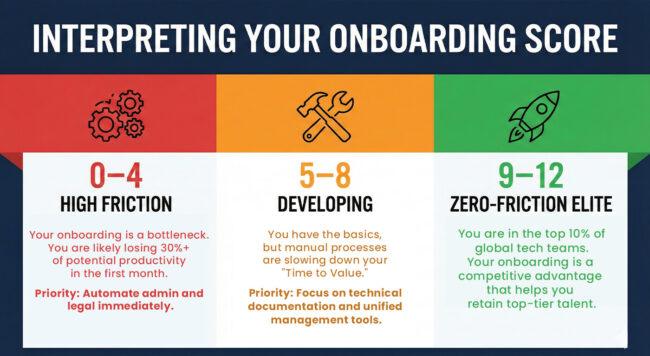
VII. The Zero-Friction Onboarding Scorecard: Audit Your Process
Use this scorecard to evaluate your current remote onboarding efficiency. Assign 1 point for every “Yes.”
Category 1: Administrative & Legal (The Plumbing)
- [ ] Are contracts localized and legally vetted for the developer’s specific country?
- [ ] Is payroll automated, handling global taxes and exchange rates without manual HR intervention?
- [ ] Does the developer have all necessary hardware and software access 24-48 hours before Day One?
- [ ] Is there a signed, global-compliant IP protection and NDA in place?
Category 2: Technical Velocity (The Work)
- [ ] Is your “Golden Path” (local environment setup) documented well enough for a zero-question setup?
- [ ] Is the first task (the “Small Win”) assigned and ready before the developer starts?
- [ ] Do you have a “Buddy System” that pairs every new hire with a non-manager technical peer?
- [ ] Can a developer realistically submit their first Pull Request (PR) within 72 hours?
Category 3: Management & Culture (The Long-Term)
- [ ] Do you use a unified dashboard for time-tracking, leave, and performance monitoring?
- [ ] Are 30-60-90 day KPIs clearly defined and visible to the developer from week one?
- [ ] Can you transition a developer from part-time to full-time (or vice versa) in under 24 hours?
- [ ] Is there a centralized portal for the developer to manage their own IT assets and benefits?
VIII. Why a Strategic Partner is the Only Path to Zero Friction
Managing global recruitment, localized contracts, international payments, compliance, and performance management is a massive operational burden. If your engineering managers are doing this work, they aren’t managing engineers.
Choosing the right hiring partner is the ultimate “Friction Killer.”
Platforms like eDev provide the infrastructure that allows tech companies to scale without the administrative headache. We don’t just find you the top 1% of global developers; we provide the Hire-to-Retire management suite that keeps them integrated, compliant, and productive.
The eDev Advantage for Global Teams:
- Expert Vetting: Tech-powered but Human-led vetting ensures you only hire “A-Players.”
- Integrated Management: Performance, leave, and IT assets are managed in one dashboard.
- Zero Compliance Risk: We handle the legal and tax complexities in 50+ jurisdictions.
- Flexible Engagement: Seamlessly scale up or down as your project matures.
Conclusion: Onboarding as a Competitive Advantage
In 2026, the battle for talent is won or lost in the first 90 days. Companies that treat onboarding as a manual, fragmented process will suffer from high churn and slow shipping cycles. Companies that treat it as a Zero-Friction system, leveraging automation, deep documentation, and strategic partners like eDev, will build the world-class products of tomorrow.
Don’t let administrative friction slow down your innovation. Partner with eDev to build and manage your high-performing remote team with total confidence.