
In 2026, speed is the primary currency of the tech industry. For CTOs and Engineering VPs, the bottleneck is rarely a lack of ideas; it’s a lack of execution capacity. The pressure to ship faster, modernize legacy systems, and integrate emerging tech (like AI) is relentless.
But here is the hard truth: Technical architecture is useless without people architecture.
When your roadmap outpaces your current team’s capacity, you face a critical fork in the road.
Do you hire a freelancer, a nimble, short-term mercenary to plug a gap? Or do you invest in a dedicated developer, a long-term missionary who embeds deeply into your product vision?
Making the wrong choice doesn’t just cost money; it creates “cultural debt,” slows down velocity, and introduces security risks.
According to the U.S. Department of Labor, the cost of a bad hire can equal 30% of the employee’s first-year earnings.
For a senior full-stack developer, that’s a six-figure mistake.
This guide breaks down the realities of both models, providing a framework for CTOs to make the right choice for their current stage of growth.
1. The Freelancer: The Agile Mercenary
A freelance full-stack developer is an independent contractor operating as their own business. They usually work with multiple clients simultaneously, are paid by the hour or by the project, and handle their own taxes, equipment, and benefits.
They are the special forces of the development world: parachute in, execute a specific mission, and extract.
When Are Freelancers Useful?
Freelancers are the ideal solution for defined scopes with clear endpoints. They offer high agility with low long-term commitment.
- Plugging Specific Skill Gaps: You have a strong Rails team but need to integrate a specific Python-based AI model. A freelance Python specialist is perfect.
- The “Disposable” MVP: You need to build a Proof of Concept (PoC) to test a hypothesis over a weekend hackathon. Speed and cost are more important than maintainable code.
- Handling Short-Term Spikes: Your e-commerce platform needs extra hands on deck for Black Friday preparation, but you won’t need that capacity in January.
The Risks of the Gig Economy Model
While flexible, relying on freelancers for core product development introduces significant friction.
- The “Context Switching” Tax: Because they juggle multiple clients, their mental energy is divided. They are rarely thinking about your product when they are offline.
- Lack of Long-Term Ownership: A freelancer is incentivized to finish the ticket, not necessarily to optimize the architecture for next year’s scale. This often leads to technical debt that your core team has to pay down later.
- Availability Volatility (Ghosting): Their availability is not guaranteed. If a bigger client comes along, your project might slide down their priority list.
2. The Dedicated Developer: The Embedded Missionary
Dedicated full-stack developers are, for all intents and purposes, members of your team. They work full-time (usually 40 hours/week) exclusively on your projects. They attend your daily standups, actively participate in sprint planning, and are integrated into your company’s communication channels (Slack, Teams, etc.).
While they may be hired through a partner platform like eDev, their day-to-day management and functional direction come directly from you.
When Are Dedicated Developers Useful?
Dedicated developers are essential when context, continuity, and culture are required for success.
- Core Product Development: When building the main SaaS platform that generates your revenue. You need developers who understand why a feature is being built, not just how to code it.
- Long-Term Roadmaps: Projects that will evolve over 6–24 months require developers who remember why certain architectural decisions were made six months ago.
- Protecting IP and Security: For Fintech, Healthtech, or any data-sensitive industry, dedicated teams offer vastly superior security protocols and IP protection compared to a revolving door of freelancers.
The “Commitment Phobia” Challenge
Historically, the downside to dedicated remote teams was the administrative burden: lengthy recruitment cycles, complex global payroll, and the risk of “bad fits” that were hard to offboard. This is where modern platforms like eDev have changed the game.
3. Why Dedicated Developers from a Platform Like eDev Beat Freelancers
Many CTOs hesitate to hire dedicated remote developers because of the perceived administrative friction and the fear of making a bad long-term hire.
A strategic hiring partner like eDev bridges the gap, offering the stability of a dedicated team with the flexibility usually associated with freelancers.
Here is why a managed, dedicated model is superior for scaling companies:
A. Vetting: The Top 1% vs. The Open Market
Freelance marketplaces like upwork and its alternatives are noisy. You have to sift through hundreds of proposals to find one viable candidate.
eDev uses a rigorous, multi-stage vetting process that includes technical challenges, live coding interviews, and soft-skills assessments. We present you with the top 1% of pre-vetted candidates who are ready to interview instantly. You spend your time assessing cultural and role fit, not filtering basic competency.
B. Structured Onboarding Improves Retention
A freelancer often gets a login and a “good luck.” A dedicated developer via eDev gets a structured on-ramp.
The importance of this cannot be overstated. According to SHRM’s 2025 Onboarding Research, organizations that implement structured, formal onboarding programs experience 50% higher new-hire retention and 62% greater productivity.
When you hire through eDev, you aren’t just getting a resume; you are tapping into a system where the “first-day friction” is eliminated. By the time your developer starts, their hardware access, security protocols, and cultural orientation are already underway
C. Elasticity Without Penalty
The biggest fear with dedicated hiring is being “locked in.” What if the roadmap changes?
eDev solves this with elastic hiring models. You can start a dedicated developer on a pay-by-the-hour contract to test the waters. If it’s a fit, you transition them to full-time employees through an Employer of Record. If your needs scale down, you can reduce the team size without burdensome severance packages or legal hurdles. It is the stability of a full-time employee with the agility of a contractor.
4. The CTO’s Decision Matrix: How to Choose
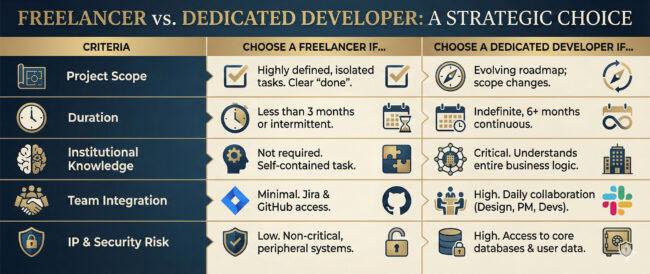
Navigating the choice between a temporary mercenary and an embedded partner requires more than just a gut feeling; it requires a cold, hard look at your project’s long-term “health stats.” If you’re struggling to decide whether your current bottleneck requires a quick fix or a foundational pillar, you need a framework that evaluates the structural requirements of the task at hand. By auditing your specific needs against the following five core variables, ranging from project scope and institutional knowledge to security risk, you can move past “analysis paralysis” and align your hiring strategy with your product’s actual growth trajectory in 2026.
Final Thoughts:
Freelancers are an excellent tool for a CTO’s toolkit, they are the variable capacity needed for temporary surges. But you cannot build a sustainable, scalable product on a foundation of variable capacity.
To build a great product, you need a team that feels a sense of ownership. You need developers who wake up thinking about how to make your application better, faster, and more secure.
Hiring dedicated full-stack developers provide the continuity and cognitive investment that freelancers simply cannot offer. By partnering with eDev, CTOs can access this high-caliber global talent, secure in the knowledge that the compliance, vetting, and management infrastructure is already built for them.
Is your roadmap moving slowly? Book a free consultation with eDev today and get matched with vetted, dedicated full-stack developers in 48 hours.